Upright
Marriage · Alliance · Captivity · Servitude · Mercy · Goodness · Inspiration · The man to whom the Querent has recourse
Reversed
Society · Good understanding · Concord · Overkindness · Weakness
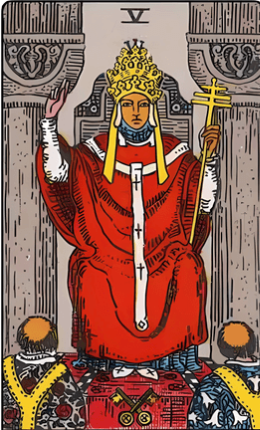
He wears the triple crown and is seated between two pillars, though not those of the Temple guarded by the High Priestess. In his left hand, he holds a scepter ending in the triple cross, and with his right hand he gives the well-known ecclesiastical sign—called the sign of esotericism—distinguishing between the manifest and concealed parts of doctrine. It is notable in this context that the High Priestess makes no such sign.
At his feet lie crossed keys, and two priestly ministers in albs kneel before him. He has usually been called the Pope, which is a particular expression of the broader role he symbolizes. He represents the ruling power of external religion, just as the High Priestess embodies the hidden, esoteric power.
The meanings of this card have often been distorted by various interpretations. Grand Orient correctly states that the Hierophant represents the power of the keys, exoteric orthodox doctrine, and the outer life that leads toward spiritual truth. However, he is certainly not the prince of occult doctrine, as some have claimed.
Rather, he is the summa totius theologiæ—the sum of all theology—when it has crystallized into rigid structure. He also symbolizes all that is righteous and sacred on the manifest plane. As such, he is the channel of grace within the world of institutions, distinct from the natural world, and he acts as a leader of collective salvation.
He is the order and head of the recognized religious hierarchy, a reflection of a higher, divine order. Yet it may happen that the pontiff forgets the symbolic nature of his role and behaves as if he contains all that his position signifies.
He is not philosophy—except perhaps in its theological form. He is not inspiration, and he is not religion itself, though he is one mode through which religion is outwardly expressed.