Upright
stability · power · protection · realization · aid · reason · conviction · authority · will · a great person
Reversed
benevolence · compassion · credit · confusion to enemies · obstruction · immaturity
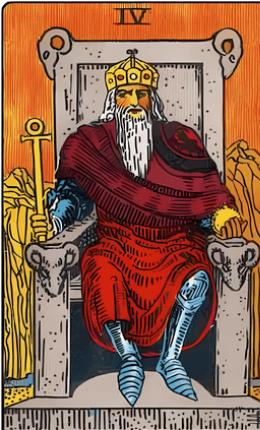
He holds a scepter in the form of the Crux Ansata and a globe in his left hand. He is a crowned monarch—commanding, stately, seated on a throne, the arms of which are fronted by rams’ heads. He represents executive authority and realization: the power of this world, here clothed with the highest of its natural attributes.
He is sometimes shown seated on a cubic stone, though this adds confusion to certain aspects. He embodies virile power, to which the Empress responds. In this sense, he is the one who seeks to lift the Veil of Isis—yet she remains virgo intacta.
It should be noted that this card, like that of the Empress, does not strictly represent the condition of married life, though that state is implied. On the surface, they stand for mundane royalty—raised to the seats of the mighty. But beyond this, there is a suggestion of a deeper, unseen presence.
They also signify—especially the male figure—the higher kingship that occupies the intellectual throne. His domain is that of thought, rather than the animal world. Both figures are ‘full of strange experience,’ each in their own way, but theirs is not a wisdom that consciously draws from higher realms.
The Emperor has been described as (a) will in its embodied form—though this captures only one aspect—and (b) as an expression of potentialities within the Absolute Being, though this latter interpretation veers into fantasy.